Roof dryer vent cleaning in Tempe
Included in the $99. Not an upcharge, not a reason to turn the job down, and not something we discover at your door and renegotiate.
Calls answered 7am to 8pm · same-day service usually available
Laundry room upstairs? It almost certainly vents through the roof. Still $99.

Tempe splits north and south on this
Most cities are mixed. Tempe is unusually clear-cut, and knowing which side you are on saves you a phone call.
North and central Tempe is mostly single story from the thirties through the sixties. Those homes run the duct up about eight feet inside the wall and out the exterior wall nearest the dryer. No roof involved, short run, straightforward job. Some of the retrofitted ones in Maple-Ash go up through the roof because somebody improvised, but that is the exception rather than the design.
South Tempe is a different city. Warner Ranch, Circle G at The Lakes and the rest of 85284, built in the eighties and nineties on larger lots with two-story plans and upstairs laundry. Once the laundry moved to the second floor the vent had nowhere sensible to go but up and out the roof.
The code math, and why it matters to you
This is the part most homeowners have never been told, and it explains a great deal about why these runs struggle.
The International Residential Code caps a dryer exhaust run at 35 feet of equivalent length. Every 90-degree elbow deducts 5 feet from that allowance, every 45 deducts 2.5. Two 90s leaves an effective 25 feet. Three leaves 20. Four leaves 15.
A south Tempe roof run on a larger house is routinely 30 to 35 feet of actual pipe with three or four elbows. Run that arithmetic and many are at or past the allowance as originally built.
Nobody cheated and nothing is defective. But it means the run has close to zero margin, and a quarter inch of lint on the walls of a duct already at the limit is the difference between a dryer that works and one that does not.
Duct length limits per the International Residential Code, Section M1502.4. Requirements vary by municipality, so confirm local code before modifying any duct run.
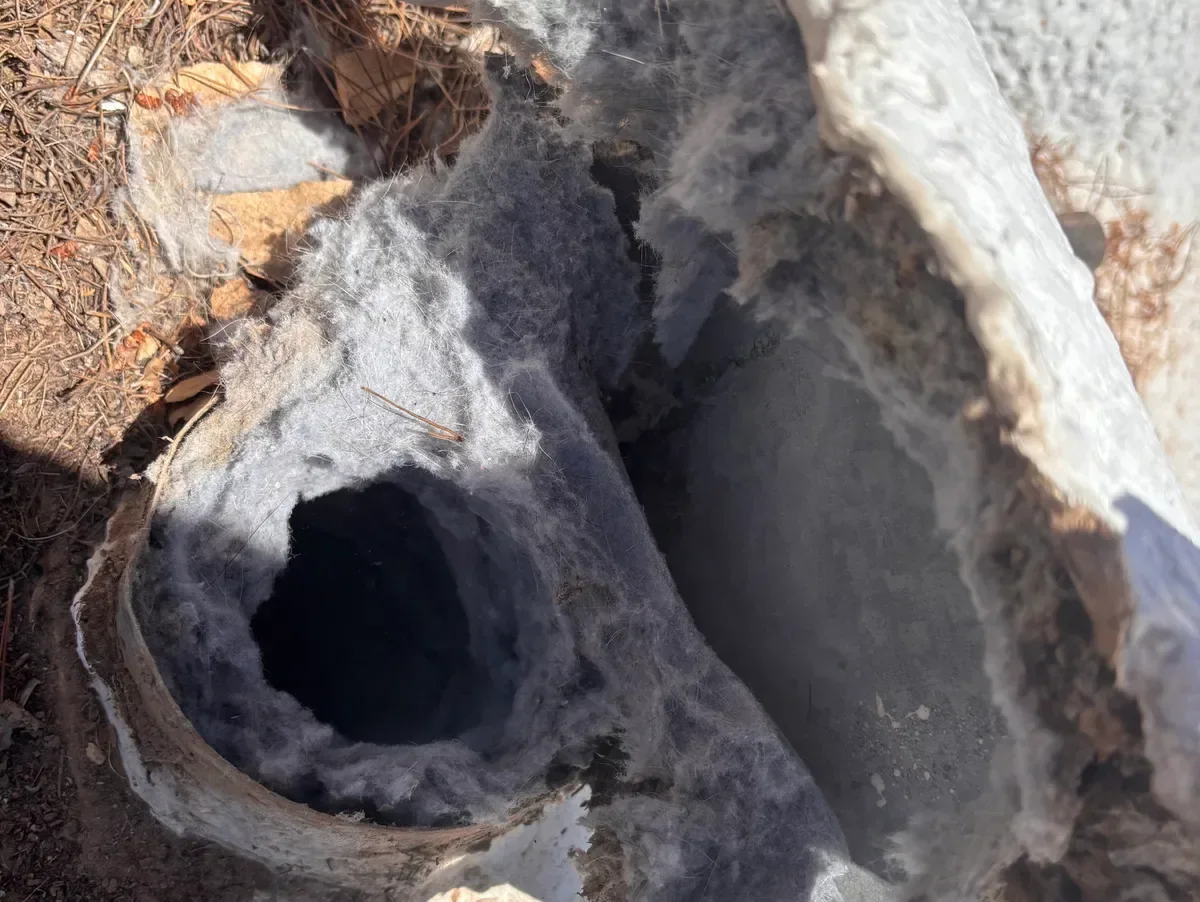
Why roof runs clog faster
Length
More duct means more interior surface for lint to catch on. A thirty-foot run has roughly four times the surface of an eight-foot one.
Elbows
Every bend slows the airflow, and slower air cannot hold its lint. Bends become collection points, and once anything settles there the channel narrows, air slows further, and more falls out. The process feeds itself.
Gravity
This is the overlooked one. In a horizontal duct, lint that does not exit just rests where it lands. In a vertical run, anything that fails to reach the top returns under gravity and piles up at the bottom, at the first bend, or right behind the machine.
That last point is also why we run the dryer while we are working the cap. The air it is pushing carries the material we agitate up and out instead of letting gravity drop all of it back down the pipe we are trying to clear.
Why some companies avoid this work
Because the work is heavier and the risk is real, while the simple money is in ground-level side-wall terminations. A roof job means the ladder comes out, you climb two stories, and you cross concrete tile in full sun without cracking a single piece.
Before you book anyone for a two-story south Tempe home, ask one question: is roof access included in that price?
How we clean a roof-terminated vent
- Check the cap first. From the roof, before anything else. Nest, flapper stuck open or seized, cracked hood, or a screen a previous owner fitted with good intentions.
- Work the termination with the dryer running. The machine stays running the entire time we are up there, so the air it is pushing carries the lint we agitate straight out of the cap rather than letting it fall back down thirty feet of pipe. It makes a mess on the roof and below it. We clean that up.
- Then work it from the dryer end. Machine unplugged, hose disconnected, dryer pulled back, brush fed up into the run and everything it frees brought down and vacuumed out of the wall.
- Both ends, because a roof run needs it. A brush fed from one end alone never properly reaches the far half of a thirty-foot run with three elbows.
- Reconnect, run it, show you. The pile out of a long roof run is usually worth seeing.
About walking your roof
We have been doing this long enough to know how to move on a tile roof and where the structural points are, so nothing cracks under weight. Concrete tile is unforgiving about that, and a cracked tile turns into a leak the next time the monsoon actually delivers.
If the roof will not take us safely, we stay off it. Steep pitch, sun-damaged or already-cracked tile, whatever the cause. The run gets done from the interior instead and you hear exactly that from us. Trading damage to your roof for a faster job is not something we are willing to do.
Worth fixing while we are up there
- A flapper rusted or lint-jammed open, an open invitation to birds
- A missing or cracked hood letting rain into the duct
- No bird guard on an otherwise sound cap
- A cap screened over by a previous owner, which the code prohibits because lint clogs screens fast
- A cap never properly sealed to the roof
We are not a roofing company and will not pretend to be. But we are up there anyway, and telling you what we see costs nothing.
Roof vent questions
Do you charge extra for roof dryer vents in Tempe?
No. Roof terminations are included in the $99 flat price. In south Tempe the roof vent is the normal case for two-story homes rather than an exception worth surcharging.
Will you walk on my tile roof?
Yes, and we know where to step. Concrete tile cracks if weight goes in the wrong place, so we work off the structural points. If a roof is genuinely unsafe to walk we say so and clean the run from the interior only, and we tell you that is what we did.
Is there a limit on how long a dryer run can be?
Yes, and it catches a lot of south Tempe homes. The residential code sets a maximum equivalent length of 35 feet and deducts 5 feet for each 90-degree elbow and 2.5 for each 45. Three 90s leaves about 20 feet of allowance. Plenty of runs out here are at or past that line as originally built, which is why they have so little tolerance for lint.
How do I know if my vent goes out the roof?
If your laundry room is upstairs and there is no vent flap on an exterior wall nearby, it goes out the roof. Look for a small hooded cap above the laundry side of the house. If you are in Warner Ranch, Circle G at The Lakes or most of the two-story stock in 85284, assume yes.
What about the older single-story parts of Tempe?
Usually a non-issue. North and central Tempe is mostly single story with side-wall terminations, and the roof work here is concentrated in the south of the city.
What if my roof cap is damaged?
We will tell you and show you. A cracked hood or a flapper stuck open is how birds and rain get in, and it is far easier to deal with while we are already up there than as a separate trip.
Calls answered 7am to 8pm · same-day service usually available
$99 flat, same as any other vent in Tempe.